The Business Research Company’s Gas Engines Global Market Report 2026 – Market Size, Trends, And Forecast 2026-2035
LONDON, GREATER LONDON , UNITED KINGDOM, October 27, 2026 /EINPresswire.com/ — The gas engines market is an essential segment within the broader energy equipment industry, reflecting ongoing technological advancements and shifting energy policies worldwide. With rising demand for cleaner and more efficient power solutions, this market is steadily carving out a significant niche, driven by innovation and global energy transitions. Let’s explore the current landscape, key drivers, regional dynamics, major players, and emerging trends shaping the future of the gas engines market.
Market Size and Growth Outlook for the Gas Engines Market
Projected to surpass $7 billion by 2030, the gas engines market represents a focused area within the expansive Engine, Turbine, and Power Transmission Equipment sector, which is expected to reach around $880 billion by the same year. Gas engines account for roughly 1% of this parent market. When considering the entire Machinery industry, forecasted at $5.28 trillion by 2030, gas engines make up nearly 0.1% of the total value. The sector is anticipated to grow at a steady compound annual growth rate (CAGR) of 6% through 2030, driven by increasing adoption and technological improvements.
Request A Free Sample Of The Gas Engines Market Report
https://thebusinessresearchcompany.com/sample_request?id=67728086&type=smp&name=Gas%20Engines%20Market%20Report%202026&utm_source=EINPresswire&utm_medium=Paid&utm_campaign=Oct_PR
Dominant Region in the Gas Engines Market by 2030
Asia-Pacific is set to lead the gas engines market in 2030, with an estimated value of $2.8 billion, rising from $1.9 billion in 2025. This represents an impressive CAGR of 8%. The region’s growth is propelled by expanding natural gas pipelines and LNG infrastructure, rising demand for distributed and captive power generation, industrialization, and increasing electricity consumption in emerging economies. Investments in combined heat and power (CHP), emission-reducing policies, and a broadening use of gas engines in commercial, utility, and industrial sectors in countries like China, India, Japan, South Korea, and Southeast Asia play crucial roles in this expansion.
Leading Country in the Gas Engines Market Forecast
The United States is expected to hold the top position country-wise in the gas engines market by 2030, with a projected valuation of $1.6 billion, up from $1.3 billion in 2025, growing at a CAGR of 4%. Growth factors include abundant shale gas production, replacement of older diesel generators with cleaner gas alternatives, the demand for reliable onsite backup power across commercial and industrial facilities, modernization efforts in utility and municipal infrastructures, and expanding use of gas engines in data centers and healthcare environments. Continued investments in decentralized energy generation also support this steady expansion.
Access The Detailed Gas Engines Market Report Here
https://thebusinessresearchcompany.com/report/gas-engines-global-market-report?utm_source=EINPresswire&utm_medium=Paid&utm_campaign=Oct_PR
Key Factors Propelling Gas Engines Market Growth
The gas engines market is driven by three major forces that are expected to accelerate growth through 2030. Firstly, the increasing utilization of gas engines in power generation and mechanical drive applications offers reliable, efficient, and flexible energy solutions for various industries and distributed projects. Such engines provide stable output with rapid start-up times, helping to balance fluctuating demand while reducing operational costs and boosting efficiency. This trend alone is estimated to contribute approximately 1.5% annual growth.
Tighter environmental regulations also play a significant role in propelling the gas engines market. Governments and agencies worldwide are imposing stricter carbon emission limits to reduce greenhouse gases and improve air quality. Compared to coal and diesel counterparts, gas engines produce lower levels of carbon dioxide, sulfur oxides, and particulate matter. As a result, utilities and industrial operators increasingly invest in gas engines to comply with regulations, avoid penalties, and achieve sustainability goals. This regulatory pressure is projected to add about 1.4% growth annually.
Government initiatives focused on expanding and modernizing power generation infrastructure represent the third key growth driver. Many countries prioritize grid enhancement, wider energy access, and meeting rising electricity demand by promoting natural gas-based generation. Gas engines are favored for their rapid deployment, dependability, and suitability for distributed energy, backup power, and rural electrification projects. These policy efforts are expected to support roughly 1.3% yearly market growth.
Fuel Types Offering Significant Market Expansion
Among fuel types, natural gas, special gas, and other fuels are projected to collectively add over $1.5 billion in value to the gas engines market by 2030. Natural gas alone is anticipated to contribute a $1 billion increase, special gas $0.4 billion, and other fuels $0.1 billion between 2025 and 2030. This growth is fueled by investments in decentralized power generation, industry adoption of low-emission gaseous fuels, advancements in high-efficiency engine technologies, and the use of renewable and waste-derived gases as alternative fuels. The demand for reliable continuous and backup power, coupled with policies favoring cleaner and more efficient energy, further supports these fuel segments.
Dominance of Natural Gas Engines in the Market
Natural gas engines will remain the largest fuel segment by 2030, accounting for about 66% of the market or approximately $5 billion in value. This dominance is backed by expanding pipeline infrastructure, preferences for lower-carbon stationary power generation, integration with microgrids and hybrid energy systems, advanced combined heat and power solutions, improved combustion and emissions controls, and favorable fuel economics. These factors encourage long-term adoption across industrial, commercial, and utility sectors.
Additional Segmentation of the Gas Engines Market
The gas engines market is broken down by power output into several bands: 1-2 megawatts (MW), 2-5 MW, 5-15 MW, and above 15 MW. Application-wise, it covers power generation, mechanical drive, cogeneration, and other uses. End users include utilities, marine industries, oil and gas, manufacturing, and various other sectors, reflecting the wide applicability of gas engine technologies.
Modular Gas Engine Plants Adding Flexibility and Resilience
Modular gas engine power plants are reshaping the market by enhancing energy security, grid flexibility, and the integration of renewable energy sources. For example, in February 2026, Rolls-Royce Power Systems introduced modular gas engine plants with scalable capacities ranging from 5 MW to several hundred megawatts. These modular solutions facilitate flexible, decentralized energy production, accelerate installation timelines, and improve grid stability by managing the variability associated with renewable energy sources.
Market Concentration and Leading Players
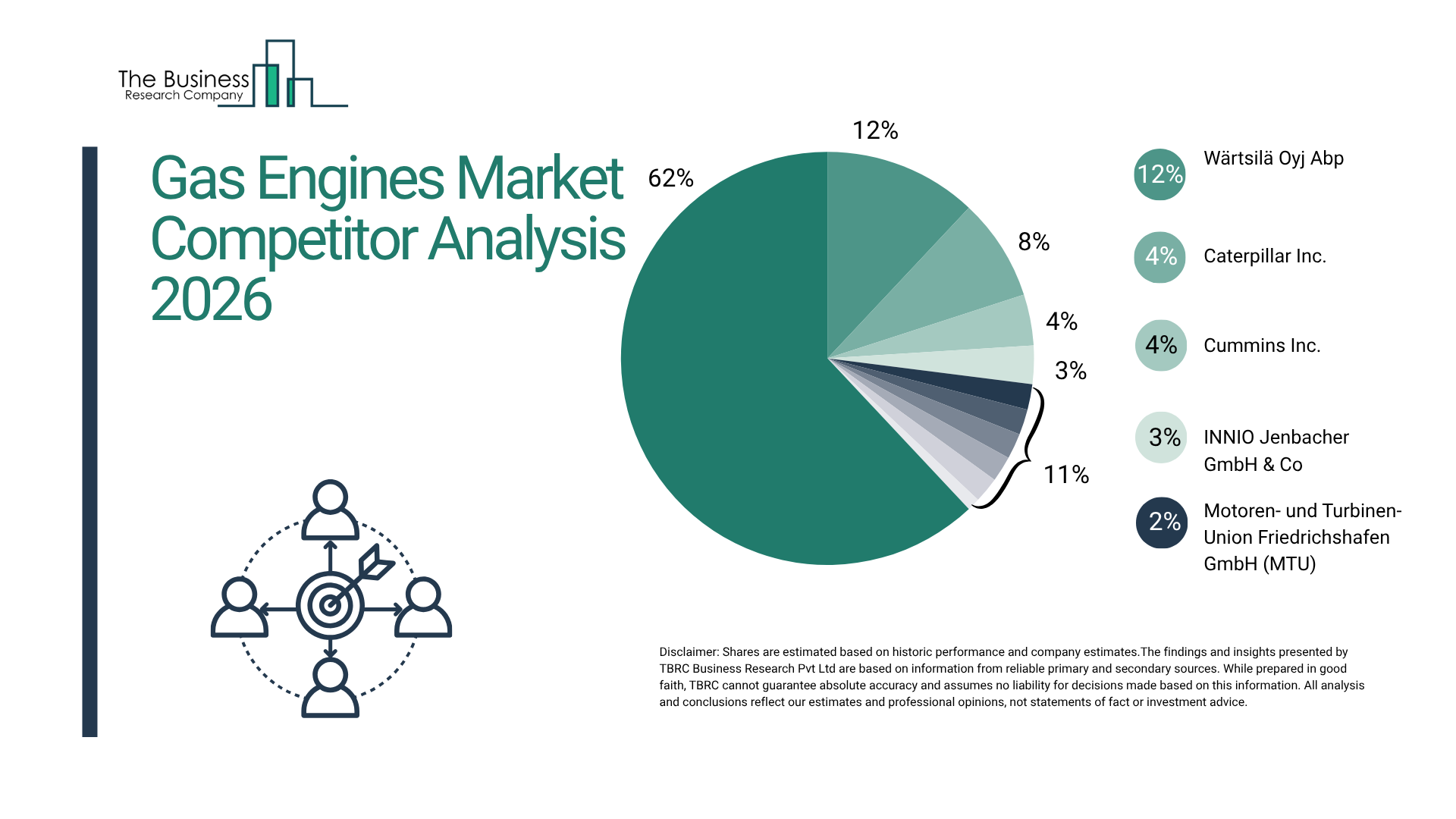
The gas engines market remains moderately concentrated, with the top 10 companies generating 38% of total revenue in 2025. This concentration is influenced by stringent emission regulations, technical challenges in engine development, and the demand for precision engineering and reliable power generation equipment. Leading firms hold significant market positions through diverse product offerings, strong industry partnerships, global manufacturing and distribution networks, and ongoing innovation. As the demand for efficient distributed power and low-emission technologies grows, these companies are expected to reinforce their market leadership through collaboration, product development, and strategic geographic expansion.
Market Share Breakdown of Top Companies in 2025
Wärtsilä Oyj Abp emerged as the market leader in 2025 with a 12% share. Following it are Caterpillar Inc. at 8%, Cummins Inc. with 4%, INNIO Jenbacher GmbH & Co at 3%, and several other key players including Motoren- und Turbinen-Union Friedrichshafen GmbH (MTU), Mitsubishi Heavy Industries Ltd, Everllence, Kawasaki Heavy Industries Ltd, Hyundai Heavy Industries Co Ltd, and Yanmar Co Ltd holding between 1% and 2% market shares.
Competitive Strategies Defining the Gas Engines Market
Companies are focusing on advancing gas engine technologies to boost efficiency and enable sustainable power generation. Innovation in engine design aims to increase performance while reducing emissions. Expanding distributed power infrastructure is also a priority to enhance energy security and grid resilience. Furthermore, integrating digital monitoring systems helps optimize engine performance and streamline maintenance operations, enabling more efficient and reliable service.
Top Supplier in the Gas Engines Sector During 2025
According to The Business Research Company, Wärtsilä Oyj Abp led global sales in the gas engines market in 2025, capturing 12% of the market. Its power generation division offers gas engine power plants and flexible energy solutions, incorporating advanced engine technologies that support distributed generation, industrial applications, and energy transition initiatives.
Key Industry Players Across the Gas Engines Market
Besides Wärtsilä Oyj Abp, notable companies in this market include Caterpillar Inc., Cummins Inc., INNIO Jenbacher GmbH & Co, Motoren- und Turbinen-Union Friedrichshafen GmbH (MTU), Mitsubishi Heavy Industries Ltd, Everllence, Kawasaki Heavy Industries Ltd, Hyundai Heavy Industries Co Ltd, Yanmar Co Ltd, Deutz AG, Fairbanks Morse Defense, Liebherr-International AG, 2G Energy AG, Generac Power Systems Inc, Baudouin, Guascor Power, KUBOTA Corporation, Ningbo C.S.I. Power & Machinery Group Co. Ltd., and Googol Engine Tech Co Ltd.
Supply Chain Overview from Components to End Users
The supply chain for gas engines involves numerous raw material providers such as Wärtsilä Corporation, Caterpillar Inc., Cummins Inc., INNIO Jenbacher GmbH, Rolls-Royce Holdings plc, Mitsubishi Heavy Industries Ltd., Kawasaki Heavy Industries Ltd., Hyundai Heavy Industries Co., Ltd., MAN Energy Solutions SE, Liebherr International AG, Yanmar Holdings Co., Ltd., Doosan Enerbility Co., Ltd., Volvo Penta AB, Scania AB, Deutz AG, Weichai Power Co., Ltd., Kubota Corporation, IHI Corporation, Toshiba Energy Systems & Solutions Corporation, Siemens Energy AG, Bosch Rexroth AG, Tenneco Inc., Garrett Motion Inc., BorgWarner Inc., and Dana Incorporated.
Major wholesalers and distributors include companies like W.W. Grainger Inc., Fastenal Company, Applied Industrial Technologies Inc., Motion Industries Inc., MSC Industrial Supply Co., RS Group plc, Ferguson Enterprises Inc., WESCO International Inc., Rexel S.A., Sonepar Group, Graybar Electric Company Inc., HD Supply Holdings Inc., Global Industrial Company, Kaman Corporation, Airgas Inc., Linde plc, Brenntag SE, Univar Solutions Inc., Industrial Supply Company, Lawson Products Inc., MRC Global Inc., DistributionNOW Inc., and BlackHawk Industrial Distribution Inc.
Leading end users cover a wide range of sectors with key players such as Engie SA, Enel S.p.A., RWE AG, E.ON SE, Duke Energy Corporation, NextEra Energy Inc., Dominion Energy Inc., Southern Company, Exelon Corporation, Tokyo Electric Power Company Holdings Inc., Korea Electric Power Corporation, State Grid Corporation of China, China Huaneng Group Co., Ltd., NTPC Limited, Tata Power Company Limited, Reliance Industries Limited, Saudi Electricity Company, QatarEnergy, Petronas, Shell plc, BP plc, TotalEnergies SE, Equinor ASA, Chevron Corporation, and Exxon Mobil Corporation.
What’s included in our 2026 market reports:
• Market attractiveness scoring and analysis
• Total addressable market (TAM) analysis
• Company scoring matrix graphics and tables
• Excel-based forecasting dashboards
• Market hotspots infographics
• Key technologies and future trend analysis
• Updated graphics and tables
Learn More About The Business Research Company
The Business Research Company (www.thebusinessresearchcompany.com) is a leading market intelligence firm renowned for its expertise in company, market, and consumer research. We have published over 30,000+ reports across 27 industries and 60+ geographies. Our research is powered by 1,500,000 datasets, extensive secondary research, and exclusive insights from interviews with industry leaders.
We provide continuous and custom research services, offering a range of specialized packages tailored to your needs, including Market Entry Research Package, Competitor Tracking Package, Supplier & Distributor Package and much more.
Disclaimer: Please note that the findings, conclusions and recommendations that TBRC Business Research Pvt Ltd delivers are based on information gathered in good faith from both primary and secondary sources, whose accuracy we are not always in a position to guarantee. As such TBRC Business Research Pvt Ltd can accept no liability whatever for actions taken based on any information that may subsequently prove to be incorrect. Analysis and findings included in TBRC reports and presentations are our estimates, opinions and are not intended as statements of fact or investment guidance.
Contact Us:
The Business Research Company
Americas +1 310-496-7795
Europe +44 7882 955267
Asia & Others +44 7882 955267 & +91 8897263534
Email: marketing@tbrc.info
Follow Us On:
LinkedIn: https://in.linkedin.com/company/the-business-research-company.
Oliver Guirdham
The Business Research Company
+44 7882 955267
info@tbrc.info
Visit us on social media:
LinkedIn
Facebook
X
Legal Disclaimer:
EIN Presswire provides this news content “as is” without warranty of any kind. We do not accept any responsibility or liability
for the accuracy, content, images, videos, licenses, completeness, legality, or reliability of the information contained in this
article. If you have any complaints or copyright issues related to this article, kindly contact the author above.

Media gallery