
Key Takeaways
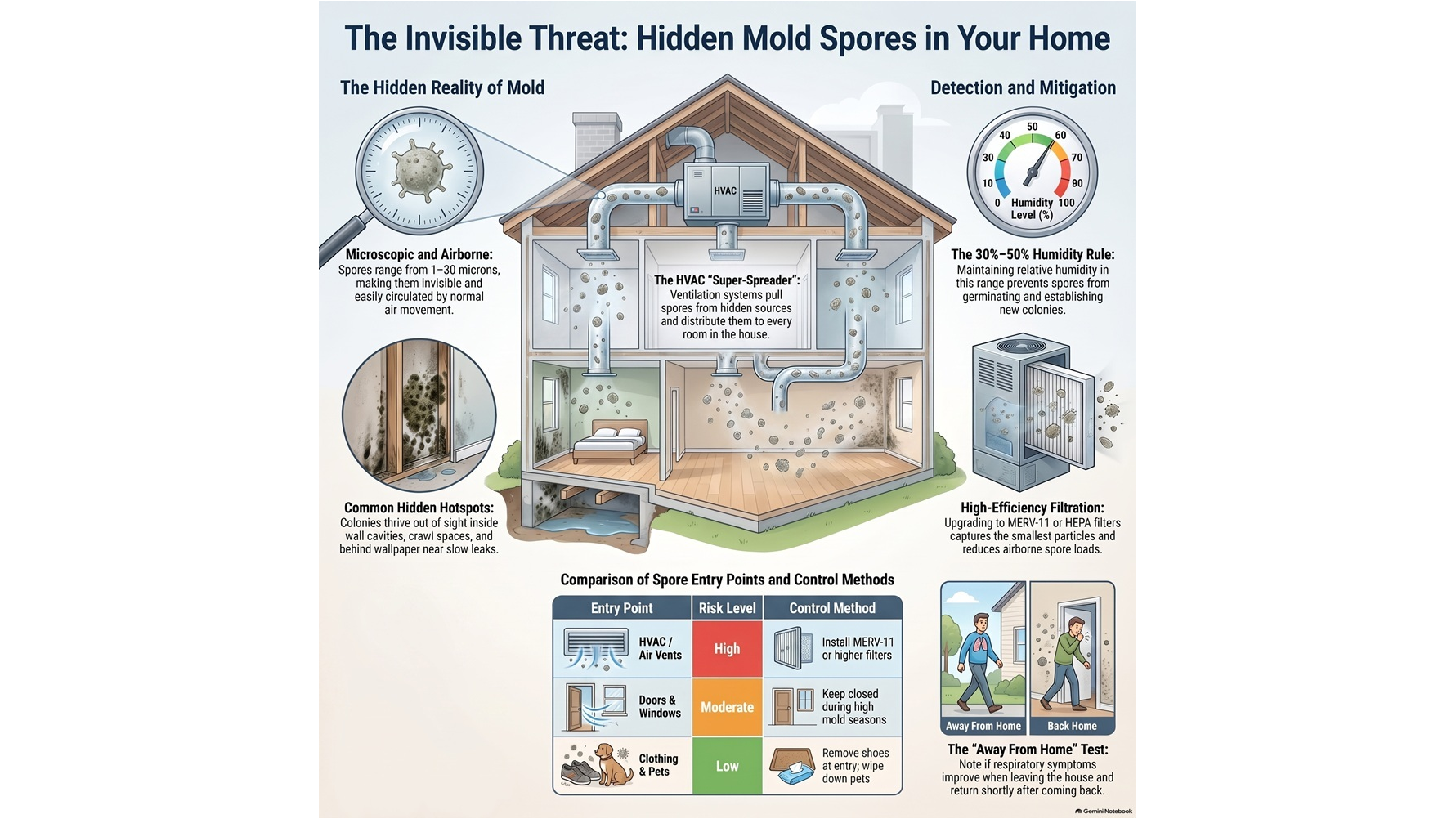
- A home can look completely clean and still have dangerously high indoor mold spore levels – spores are microscopic and invisible to the naked eye.
- Your HVAC system is one of the biggest culprits for spreading spores from a single hidden source to every room in the house.
- The telltale sign that mold – not a cold or seasonal allergies – is behind your symptoms: they consistently improve when you leave home and return when you come back.
- Moisture is the root cause of every mold problem; without fixing that first, every other solution is temporary.
- Professional air testing can confirm elevated spore levels even when no visible mold exists – keep reading to understand when that step is worth taking.
Yes – Your Spotless Home Can Have Dangerously High Spore Levels
Most people connect mold with something visible – dark patches on grout, fuzzy spots on a basement wall, obvious staining. But mold spores, the microscopic particles mold releases to reproduce, become airborne long before any visible growth appears. A room can contain thousands of spores per cubic meter of air without a single visible colony anywhere in sight.
This happens because spores don’t need a fully developed mold patch to fill the air. An early-stage colony growing inside a wall cavity or above a ceiling tile can shed spores continuously for weeks before it ever shows a stain on any surface a homeowner would actually look at. By the time something is visible, the air quality impact has already been building for some time.
For Tampa Bay homeowners dealing with unexplained respiratory symptoms or persistent allergies, this is worth taking seriously. TampaBayMold.net has published a detailed resource on exactly this scenario – whether high indoor mold spore levels can exist without any visible mold – and the answer, backed by professional air testing data, is clearly yes.
How Spores Spread Invisibly Through Your Home
Once mold establishes itself – even in a completely hidden location – spore dispersal into living spaces happens continuously. Normal air movement, foot traffic, and even opening a door can dislodge and circulate spores. Two pathways in particular deserve attention.
HVAC Systems: The Whole-Home Distribution Problem
A heating and cooling system is designed to circulate air efficiently throughout an entire home – and it does exactly that with mold spores too. If spores are present near even one return air vent, the system pulls them in, moves them through the ductwork, and delivers them to every supply vent in the building. Indoor air quality experts note that a single HVAC cycle can distribute millions of spores throughout the entire served area, turning a localized problem into a whole-home air quality issue. Low-efficiency air filters make this significantly worse, as they fail to capture the smallest spore particles.
Early-Stage Colonies Release Spores Before Any Stain Appears
Mold doesn’t wait until it’s visible to start affecting air quality. Many species can begin growing on surfaces where relative humidity is consistently high, often above 60%, and porous materials like drywall and wood can retain enough internal moisture to support mold growth even when the surface feels dry. Building science research confirms that mold can begin colonizing these materials within 24 to 48 hours of sustained dampness – well before any discoloration shows up on the surface.
Where Hidden Mold Actually Hides
If spore levels are elevated but nothing is visible, the colony is hiding somewhere specific. A few locations account for the majority of hidden mold cases in residential buildings.
Inside Walls Near Leaky Pipes
A slow pinhole leak in a supply line inside a wall cavity may never produce a visible water stain on drywall – but it keeps the structural cavity behind it consistently damp. Insulation traps that moisture against wood framing, and mold can establish an active colony within days. Spores then travel into living spaces through electrical outlets, gaps around trim, and air pressure differences between the wall cavity and the room.
Bathrooms, kitchens, and laundry rooms carry the highest risk here, simply because they have the greatest density of plumbing lines running through walls. Signs worth paying attention to: a persistent musty odor in one specific area, paint that bubbles or slightly warps, or respiratory symptoms that seem worse in one particular room.
Crawl Spaces, Attics, and Basements
These three areas share a critical characteristic: they’re the least-visited spaces in any home, so mold growth there can persist for years undetected. Crawl spaces deal with ground moisture that continuously evaporates upward through the soil. Attics develop problems through poor ventilation – warm, moisture-laden air rising from the living space below hits the cold underside of roof decking and creates repeated condensation. Basements sit below grade surrounded by moisture-retaining soil, and finished basement walls create a deceptive scenario where the structure behind them is completely hidden.
In Tampa Bay specifically, the year-round humid coastal environment means pier-and-beam crawl spaces and duct systems are among the most common sources of hidden mold – often identifiable only by a persistent musty smell with no visible growth anywhere in the home.
Symptoms That Point to High Spore Levels
Elevated spore levels don’t always cause obvious or dramatic reactions. The effects are often subtle enough that people attribute them to a persistent cold, seasonal allergies, or general fatigue – never connecting the dots back to their indoor air quality.
The Key Pattern: Symptoms Improve When You Leave Home
The most telling sign is behavioral: symptoms consistently worsen at home and improve – often within hours – when spending time somewhere else. If nasal congestion, coughing, or eye irritation clears up during a weekend away and returns within a day of coming home, the indoor environment is the most logical place to investigate. Common symptoms associated with mold spore exposure include:
- Persistent nasal congestion or runny nose not explained by season
- Itchy, watery, or red eyes that worsen indoors
- Chronic coughing or throat irritation with no viral cause
- Unexplained fatigue or headaches that improve away from home
- Worsening asthma symptoms without a clear outside trigger
Hidden mold can also release mycotoxins – toxic compounds much smaller than spores themselves – which are associated with respiratory, neurological, and immune system effects in cases of sustained exposure.
Who Faces the Highest Health Risk
Certain groups experience faster and more severe effects from the same spore concentrations that might cause only mild irritation in a healthy adult. Children under 12, elderly adults, people with asthma, those with diagnosed mold allergies, and immunocompromised individuals – including people on chemotherapy or organ transplant recipients – all face elevated risk. For anyone in these groups living with suspected mold spore exposure, the timeline for investigation and action should be compressed significantly.
What Lowers Indoor Spore Counts Without Visible Mold
Control Moisture First – Everything Else Is Secondary
Every mold problem is a moisture problem at its core. Maintaining indoor relative humidity between 30% and 50% keeps most mold species from sustaining active growth. A digital hygrometer placed in high-risk areas like bathrooms and basements gives real data to work from. Any source of liquid water intrusion – a slow-dripping pipe fitting, a hairline foundation crack, or a poorly flashed roof penetration – needs permanent repair, not just surface drying. Mold can begin colonizing damp porous materials within 24 to 48 hours, so the margin for delay is narrow.
HEPA Filtration and HVAC Filter Upgrades
True HEPA filters capture 99.97% of particles at 0.3 microns. Most mold spores range from 1 to 30 microns, putting them well within HEPA’s capture range. Portable HEPA air purifiers placed in bedrooms – where continuous overnight exposure accumulates – produce the fastest measurable short-term reduction in ambient spore counts. Running a unit on medium-to-high for 30 minutes before sleep, then lowering it for overnight operation, balances noise with effective particle reduction.
For the HVAC system, upgrading to a minimum MERV-11 rated filter – such as the Filtrete 1900 MPR found at most home improvement stores – captures a substantial portion of spores passing through the return air system. Standard fiberglass builder filters carry MERV ratings of 1 to 4 and capture virtually no mold spores. Before switching, confirm your HVAC blower motor can handle the increased static pressure of a higher-MERV filter – an HVAC technician can verify this quickly.
Important context: HEPA filtration is a mitigation tool, not a cure. It reduces what you breathe; it does not address the colony generating the spores. Both need to be tackled simultaneously for lasting improvement.
When Professional Air Testing Is the Right Call
When moisture control and filtration improvements don’t resolve persistent symptoms, or when there’s a known water damage history, a musty odor without an identifiable source, or residents with worsening respiratory conditions, professional air testing is the appropriate next step. Certified mold testing uses calibrated air sampling equipment to provide actual spore count data by species – compared against an outdoor control sample taken the same day.
That comparison is what matters. The EPA has not established federally defined numeric thresholds for residential indoor mold spore levels, so indoor counts must be evaluated relative to the outdoor baseline on the same day. When indoor levels significantly exceed outdoor levels, or when genera associated with water-damaged buildings – like Stachybotrys, Chaetomium, or Aspergillus – appear in elevated concentrations, it points to an active hidden moisture source. Inspectors also use moisture meters, thermal imaging cameras, and borescopes to locate that source inside wall assemblies and ductwork without requiring demolition. Many homes investigated for mold complaints show no visible mold at all – making instrument-based inspection the only reliable path forward in those cases.
Fix the Moisture Source – That’s What Fixes the Mold
Mold is not the underlying problem – it is the symptom of a moisture problem that hasn’t been resolved. Remediating visible colonies, running HEPA purifiers, and replacing air filters on schedule will all help, but spore levels will climb right back if the moisture source feeding that growth remains untouched. The only path to lasting improvement in indoor air quality is finding and permanently eliminating every moisture source – leaking pipes, inadequate vapor barriers, poor drainage, condensation points, ventilation failures – and then confirming through follow-up air testing that spore levels have actually responded. Fix the water, and the mold problem gets fixed at its root.
For Tampa Bay homeowners ready to stop guessing and start with real data, TampaBayMold.net provides professional mold inspection and air quality testing services built around identifying exactly what you can’t see.
TampaBayMold.net
550 N. Reo St. Suite #300
Tampa
FL
33609
United States


