There is a structural limit on the dominant “world model” design and Arya Labs introduce a physics-based alternative.
RIDEGFIELD, CT, UNITED STATES, June 15, 2026 /EINPresswire.com/ — Venture investors committed $8.8 billion to robotics startups built on a single architectural bet about how machines should learn the physical world, ARYA Labs has published a proof that the bet has a ceiling no amount of capital, data, or compute can lift.
The first preprint establishes a structural limit on the dominant world-model design, in mathematics a machine can verify. The second introduces the architecture ARYA Labs built once it understood the limit. Together they reframe the world-model category — now the largest area of AI investment outside frontier language models.
The simple version
A world model is an AI system that learns how reality behaves so a robot, vehicle, power plant, or industrial simulator can plan ahead by running the model forward. For the dominant family, known as JEPA, behind a substantial fraction of today’s world-model investment, the math now says something the market has not yet priced.
A formal proof published this quarter by Klindt, LeCun, and Balestriero established that JEPA-style models can recover the true structure of reality only when that reality behaves like a bell curve drifting gently around a mean. Most systems anyone wants to deploy world models on such as gravity, turbulence, markets, sensor noise, fluid dynamics — do not. The architecture carries a built-in bias no data or compute can remove, and it compounds: a model can be accurate on step one and architecturally guaranteed to be wrong by step ten thousand.
ARYA Labs CEO Dr. Seth Dobrin calls this pattern “right once, drift wrong.” The May 2026 stable-worldmodel benchmark put numbers on it: planning success on a leading neural world model fell from about 50 percent in clean conditions to 12 percent under an agent color change and 6 percent under a background shift, declining quadratically with distractors.
That is the ceiling. ARYA Labs published the alternative.
What ARYA built
The alternative is the Physics-Grounded Symbolic Architecture (PGSA). Rather than learning a statistical pattern of the world and hoping reality cooperates, PGSA represents the world through the symbols and physical laws that generate it. The result is a world model that does not depend on a bell-curve world and does not drift as it runs.
The two preprints are Identifiability Without Gaussianity: Symbolic World Models and Near-Infinite Temporal Consistency (arXiv:2606.12471) and ARYA: A Physics-Constrained Composable and Deterministic World Model Architecture (arXiv:2603.21340). The claims in them are not asserted in a slide deck: the algebraic cores of four central theorems are formalized in Lean 4 that is a language mathematicians use to write proofs a computer can check line by line and has zero unfinished steps.
Three numbers describe what that buys:
10⁻¹⁶ — PGSA per-step error floor, at the limit of double-precision arithmetic.
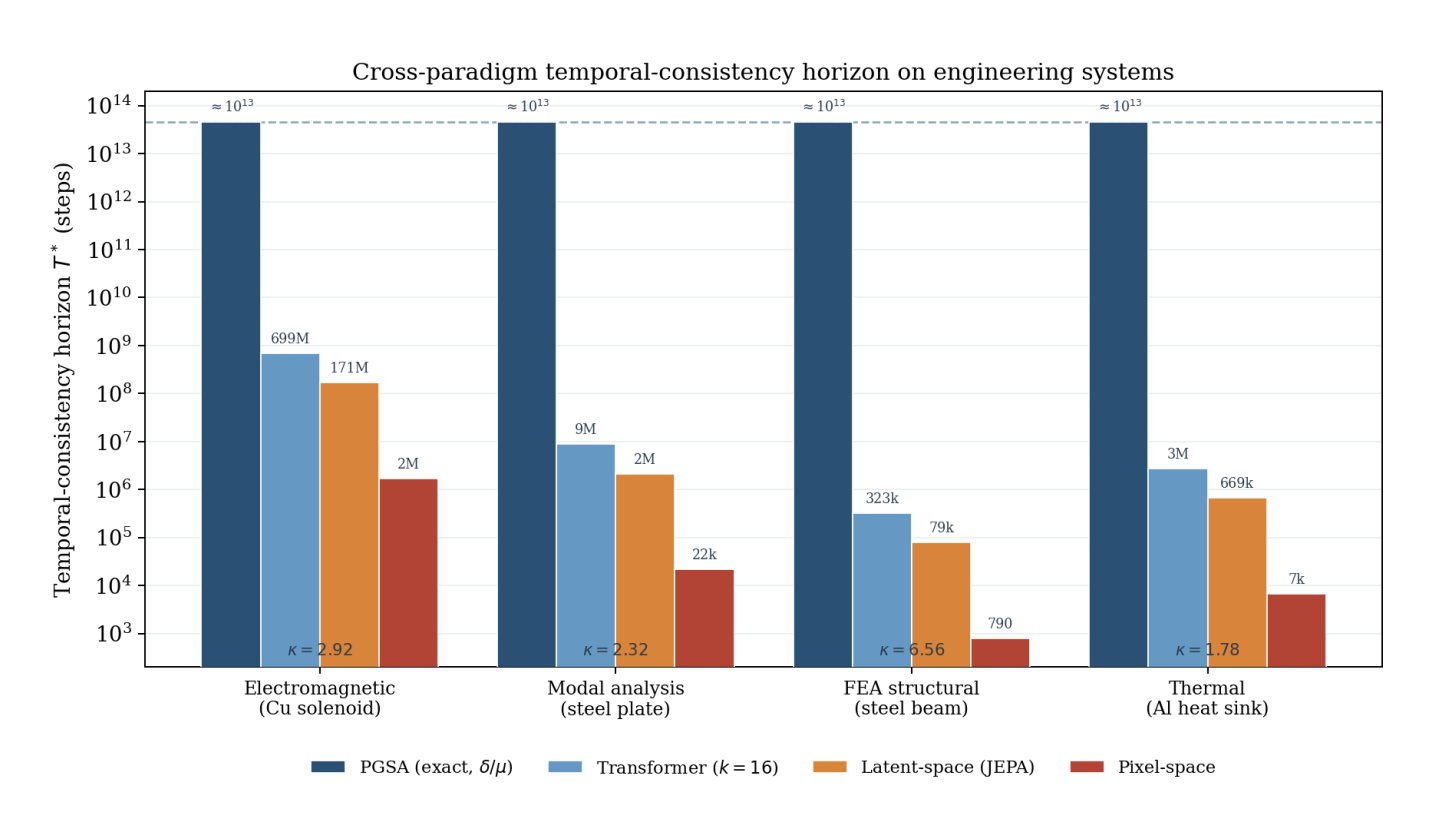
10¹³ — horizon over which PGSA holds bounded error on non-chaotic systems with known laws; statistical world models typically last hundreds to a few thousand steps.
0 — unfinished placeholders in the Lean 4 formalization of the four central theorems.
Why it matters now
Recent rounds include World Labs near $5 billion, AMI Labs’ $1.03 billion seed, Wayve’s $1.2 billion Series D, and billion-dollar-plus rounds at Figure, Skild AI, and Physical Intelligence. A substantial fraction of this capital sits in JEPA-family architectures or systems with related identifiability properties.
Pairing the Klindt–LeCun–Balestriero proof with the PGSA result means architecture — not scale, not data — determines whether a world model can be trusted on step ten thousand. For autonomous driving, robotics, industrial simulation, energy, and defense, that is the operative question.
What it is for
ARYA Labs is building AI for the physical economy: models that learn not only from digital data but from real-world trial-and-error, simulation, and physical constraints. The target is both the pharmaceutical/ & biotechnology development and the engineering & manufacturing invention loops: the design, prototyping, and validation cycles that lock in most of a physical product’s cost and performance.
The company’s has a product that is a next-generation CAD/CAE and design-space-exploration platform powered by PGSA. Unlike text-trained AI, it reasons natively over physics, geometric and material constraints, and manufacturing steps. It is aimed at the pre-production phases of jet engines, spacecraft, medical devices, electronics, automobiles, and other complex physical products.
Executive commentary
“In one quarter, the field has committed billions to world models and produced a formal proof that the dominant architecture recovers the true world only in bell-curve toy universes,” said Dr. Seth Dobrin, Chief Executive Officer and Co-Founder of ARYA Labs. “A model can be right once and drift wrong. We have shown both in machine-verified mathematics as well as in practice, this is a property of the alignment mechanism, not of world models in general.
The alternative exists, and it is published an reduced to practice today.”
“Enterprise and safety-critical operators do not buy short demos; they buy systems they can audit,” said Łukasz Chmiel, Chief Technology Officer and Co-Founder of ARYA Labs. “PGSA is deterministic, physics-native, and symbolically grounded, with error bounds you can write down and a proof you can read. That is what gets a model onto an aircraft, into a substation, or onto a factory floor.”
Verification and access
Both preprints are available immediately and freely on arXiv. The Lean 4 formalization of the four central theorems accompanies the identifiability paper. Technical briefings are available to qualified press, researchers, and enterprise prospects on request; commercial licensing of PGSA is handled separately at aryalabs.io (https://aryalabs.io).
About ARYA Labs
ARYA Labs builds AI for the physical economy. Its Constrained Deterministic AI™ engine, powered by the Physics-Grounded Symbolic Architecture, accelerates the engineering and manufacturing invention loop for jet engines, spacecraft, medical devices, electronics, automobiles, and other complex physical products — with AI that reasons over physics, constraints, and manufacturing steps rather than text.
Media Contact: ARYA Labs — media@aryalabs.io
Seth Dobrin
ARYA LABS
email us here
Visit us on social media:
LinkedIn
YouTube
Legal Disclaimer:
EIN Presswire provides this news content “as is” without warranty of any kind. We do not accept any responsibility or liability
for the accuracy, content, images, videos, licenses, completeness, legality, or reliability of the information contained in this
article. If you have any complaints or copyright issues related to this article, kindly contact the author above.

Media gallery