
Morse Micro, the world’s leading Wi-Fi HaLow silicon provider, today announced two Wi-Fi HaLow USB Dongle Reference Designs that can bring long-range Wi-Fi HaLow connectivity to existing devices via a simple USB connection.
This press release features multimedia. View the full release here: https://www.businesswire.com/news/home/20260820191322/en/
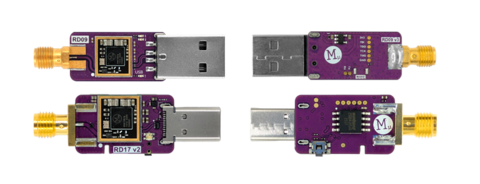
MM8108-RD09 Reference Design: USB dongle reference design that adds native Wi-Fi HaLow connectivity to existing routers, access points, PCs and other devices using Windows, Linux or macOS. MM8108-RD17 Reference Design: Driverless USB dongle reference design that brings Wi-Fi HaLow connectivity to a broad range of devices, including industrial computers, robotics, POS terminals, tablets and smartphones.
Based on Morse Micro’s market leading MM8108 SoC, both of the Morse Micro Wi-Fi HaLow USB Dongles will enable developers to activate Wi-Fi HaLow on many existing devices. Given that Wi-Fi HaLow networks provide native IP connectivity at ranges up to one kilometer, this opens up an exciting range of new possibilities.
The MM8108-RD09 Reference Design provides native Wi-Fi HaLow connectivity to a range of devices including access points (AP) and station (STA) products. OpenWRT drivers are available to enable Wi-Fi HaLow functionality on existing routers and APs with a USB interface. For client devices, native Windows and Linux drivers are available, as well as a MacOS application, which allows for users to easily connect to Wi-Fi HaLow networks, the same as one would for traditional Wi-Fi networks.
The MM8108-RD17 Reference Design allows for Wi-Fi HaLow integration into a wider range of client products without the need for drivers to be installed on the host. When plugged in, this Wi-Fi HaLow USB dongle appears as a standard CDC-NCM Ethernet interface to its host, enabling Wi-Fi HaLow connectivity to a wide range of devices including industrial computers, robotics, point-of-sale terminals, tablets and phones powered by Android or iOS. Devices can be authenticated via Wi-Fi Easy Connect (DPP) using a pairing button.
The MM8108-RD09 and MM8108-RD17 reference design schematics and software are available for tier-1 customers via their Morse Micro sales contact.
“We anticipate these USB dongle reference designs will vastly accelerate the adoption of Wi-Fi HaLow,” said Michael De Nil, co-founder and CEO of Morse Micro. “The MM8108-RD09 design enables internet service providers to upgrade existing wireless routers to provide kilometer-range Wi-Fi connectivity to their customers, while the MM8108-RD17 design enables Wi-Fi HaLow connectivity to existing devices such as laptops, phones and tablets across large properties, without the need for additional software updates.”
About Morse Micro
Morse Micro is the leading Wi-Fi HaLow fabless semiconductor company, revolutionizing IoT connectivity with award-winning technology. Headquartered in Sydney, with global offices in the United States, Taiwan, China, India, Japan and the United Kingdom, Morse Micro is driving the adoption of next-generation long-range, low-power Wi-Fi HaLow solutions. Its first-generation MM6108 and newly launched MM8108 silicon deliver the fastest, smallest, lowest-power, and longest-range Wi-Fi HaLow connectivity on the market.
Morse Micro’s Wi-Fi HaLow technology is gaining significant momentum globally, enabling connected devices to achieve ten times the range, covering 100 times the area of traditional Wi-Fi networks. This advancement is transforming IoT connectivity across various sectors, including smart homes, industrial automation, and smart cities.
View source version on businesswire.com: https://www.businesswire.com/news/home/20260820191322/en/
Media gallery


